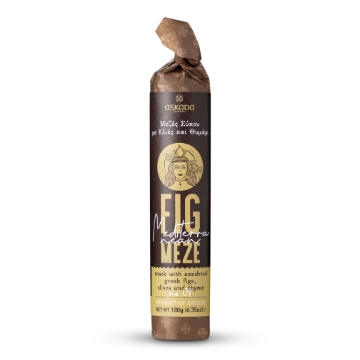
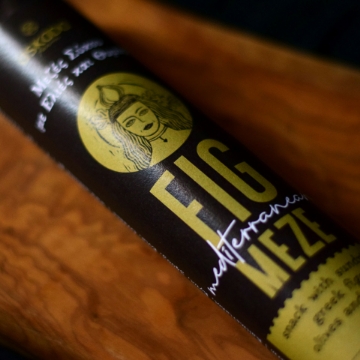
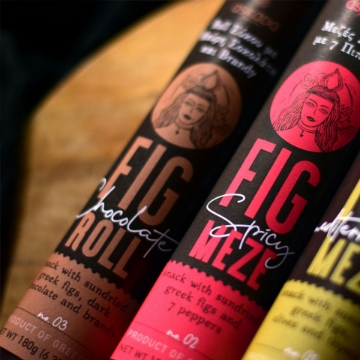
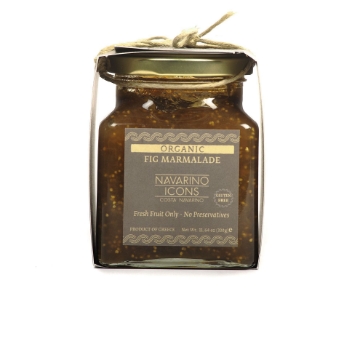
On Corfu, autumn begins in the fig trees. Across the island's terraced gardens and old stone courtyards, the fruit ripens heavy and sweet through September, and for generations the Corfiot answer to that abundance has never been jam or syrup, but something stranger and more savoury: sykomaida, the island's traditional fig pie. Not a pie in the flaky, baked sense at all, it is a dense, spoonable paste pounded from dried figs, perfumed with wine, anise and black pepper — a dish built for the table of cured meats, hard cheese and strong spirits rather than the dessert trolley.
Lazaris Distillery & Artisan Sweets, the Corfu house that has been quietly reviving the island's old recipes since Konstantinos Lazaris began the project in 2005, inspired by the kumquat fruit, continuing the island's culinary history with his team, took that same rustic fig pie and gave it a second, more indulgent life. This jar is the result: the familiar Corfiot fig paste, but with the anise and ouzo of the original recipe softened and deepened by cocoa and brandy.
A Recipe With Two Lives
The traditional dish is a paste of dried figs, marinated in red wine, and flavored with ouzo, anise, fennel seeds and black pepper — a meze built for sipping tsipouro on a cold evening, sharp and spiced rather than sweet. For this version, the Lazaris family replaced the ouzo with brandy and chocolate, turning a savoury island classic into something closer to a dark, fig-and-cocoa confection that still carries the backbone of fennel and anise underneath. It is the same fig pie Corfiot grandmothers have always made, reinterpreted for a table that wants a little more cocoa warmth and a little less aniseed bite.
What's Actually in the Jar
The ingredient list is short because it has to be — this is a product that relies on what the figs themselves bring to the table, not on fillers. It contains fig, fennel seeds, anise, cocoa (10%), must and brandy (5%). There is no added refined sugar doing the sweetening; that work is left to the concentrated, sun-ripened sugars of the dried fig itself and to the grape must folded through the paste, a technique the island has used for centuries to bind and soften dried fruit without diluting its character. Cocoa adds a bitter-dark undertone, brandy lends warmth and a faint oak sweetness, and the fennel and anise seeds remain just present enough to remind you this paste comes from a savoury tradition, not a candy one.
How It Tastes, How It Feels
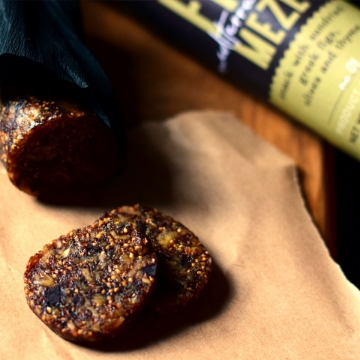
Expect something dense and almost fudge-like on the spoon, closer in texture to a thick fruit terrine than a jam — you cut it rather than spread it. The first impression is dark fig sweetness and cocoa; a beat later, the brandy's warmth arrives, and underneath it all a whisper of anise and fennel keeps the paste from ever tasting purely like dessert. It is a flavour built in layers, spicy-sweet-bitter all at once, which is exactly why its spicy character fits exceptionally with distillates such as tsipouro, ouzo, grappa and brandy.
On the Table
This is where the Corfiot fig pie shows what it was actually designed to do. It can be added perfectly as an ingredient in green salads or combined with soft goat cheese and cold cuts, cut into thin slices alongside a hard, salty cheese, or tucked next to cured pork on a grazing board where its dark sweetness plays against the fat and salt. A few thin slivers scattered over rocket with shavings of aged cheese turns an ordinary salad into something that tastes distinctly of the Ionian islands. And because the paste already carries cocoa and brandy, it sits just as naturally next to coffee or alongside a small glass of brandy after dinner as it does earlier in the meal as a meze.
Why It's Worth Seeking Out
Fig pie is a Mediterranean idea with many regional dialects — it appears in variations across lands around the Mediterranean, with the Corfiot version, sykomaida, woven tightly into the island's own gastronomy. What makes this particular jar worth having on a cheese board or in a gift box is that it isn't a mass-produced approximation of that tradition; it comes from a small Corfiot house still working in the handmade, small-batch style the island's sweets have always been made in, using fruit, alcohol and must rather than industrial fillers to build flavour. It rewards curiosity: open it expecting a sweet, and you'll find something far more complex — spiced, boozy, bittersweet and distinctly of its place.
Good to Know
- Keep in a cool and dry place, away from direct light, to preserve its texture and aroma.
- Produced in facilities that also handle eggs, nuts and sesame, worth noting if you are serving to guests with allergies.
- Once opened, treat it as you would a fine pâté or terrine: slice what you need and keep the rest tightly covered.
- Best served at room temperature, where the brandy and cocoa notes open up fully.
A small jar with a long memory behind it — part Corfiot pantry staple, part dark, brandy-warmed indulgence, and entirely its own thing on any table it joins.